In 2021, CoMA conducted a survey and found that 86% of composers who responded said they’d never worked with a Disabled musician. When they were asked why this was, a very common answer was, “I don’t know how”. We realised that the new pieces CoMA and ensembles around the country were commissioning weren’t necessarily going to be created with accessibility in mind, as composers lacked confidence and experience in writing for musicians who identified as Disabled. This narrows the scope of the commissioned music, who can play it, and who is listening to it as well.
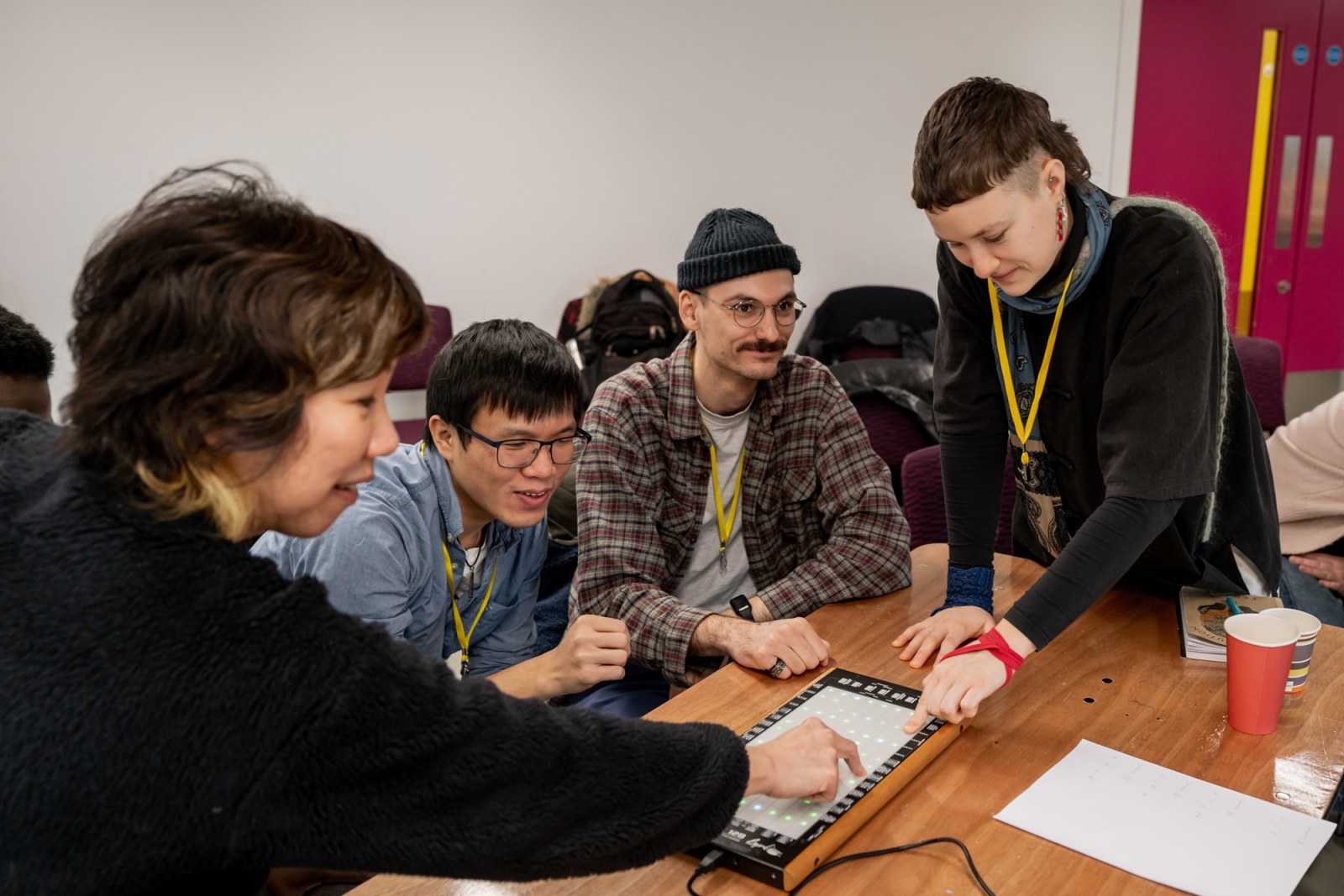
Therefore, CoMA decided to collaborate with professional Disabled musicians to develop opportunities and resources that can give composers some experience and skills in this field, and to create a space where they can ask questions about how to make their music making and compositions more accessible. Arising from this, our most recent Connect the Dots course ran as a series of workshops in January–February 2025.
Our panellists
Facilitators: music technologist Clare Johnston and Cass Alabaster, singer and a violist with National Open Youth Orchestra.
2025 Connect the Dots composer participants: Bofan Ma and Natalie Roe
You can watch the discussion by clicking the video image here, and read an edited transcript of it below.
CoMA: What does accessibility and inclusivity mean to you?
Clare: Accessibility is something that is very personalised and it has to be judged by the person who is experiencing this. It is the same with accessible music technology.
Accessible music doesn’t mean the same thing to me as it does for the next person and the next person. So accessibility for me is finding out what are the barriers that stop somebody from being able to participate in the way that they want to participate, and then overcoming those barriers.
Cass: One of the interesting things that I always find about the term accessibility is people often think that accessibility is adding on things, so they think it’s adding grab rails, adding ramps, but actually, it’s more about not doing things that exclude other people.
I think a lot of the time, accessibility is thought of as very complicated. It’s really not, because for the disabled people, accessibility is necessary. People seem to forget that for able-bodied people, accessibility is really, really convenient.
When I was doing stuff at the Royal Opera House, we were in one of the rehearsal rooms, and they put a turntable in. So, the rehearsal floor was about this far off the real floor.
And one of the staff members was like, oh my god, we’re gonna need to put a ramp in, we forgot to say, can you put a ramp in? So, they have the people who were building the rehearsal room and stuff put a ramp in. And all of the bassists and percussion players were like, this is so convenient, I love this. It’s always funny, because if you frame it as convenience for able-bodied people, it’s great. And then if you say, what if we have a ramp here for accessibility reasons? They go, access, that’s…Oh, that’s really scary!
So I think, yeah, accessibility is a lot less complicated than people sometimes make it out to be.
CoMA: Did you come away with a different idea of what accessibility meant to you from the course?
Bofan: A realisation that it is not a kind of hardcore solution to any problems, it is just a kind of mindset where we have to learn to be more adaptive and to be more able to listen to people’s different needs, and it’s more about communication for me, I think.
Natalie: [For instance] What we learned on the course was how one person who’s visually impaired deals with learning music is very different to the next, and how preparation is so key. For some people, they need to listen to the music because they can’t read a braille score, for example, whereas for others rely on a braille score. So I think that individual touch, but also communication for me, were definitely the biggest takeaways.

CoMA: What do you think are the main challenges in improving access to music?
Cass: It goes down into the logistics so much, because if you go into youth orchestras, a lot of them are building a rapport with a school where they can use their facilities.
So then if [the orchestra] says, actually, we kind of need to ditch you because we want somewhere that’s got level access, you don’t have that rapport with the place, and it’s a lot of changes. If your organisation is built on some kind of inaccessible structure, the first issue is realising in what way it’s inaccessible and then the second is trying to find some way to get around that without losing the kind of rapport that you’ve built with your existing structures.
Natalie: I would also just add, I think, definitely, right now, it feels more than ever, but financially just funding, and the amount of projects which are taking place, and I think that’s obviously a massive burden on the actual project. I would love for so many more people to do this Connect the Dots course, because it was just phenomenal, but, you know, there’s always limitations, I guess financially as well, so I know it’s a bit of a maybe an obvious, or slightly hard one to talk about, but financial concerns are real.
Clare: The financial thing actually feeds quite strongly into the other point I was going to make. If I am involved in a project, sometimes I’m saying that involves me and a personal assistant and it involves completely different transport needs from other people and I’m going to have to stay overnight, even though from somebody else’s point of view, it’s quite a small amount of travel involved, but for me, that’s far too much. So when you stack that up and you scale it to a much bigger project that involves, um, a lot of people with accessibility needs, it’s going to cost hundreds of pounds. So they want to take stuff out of it, and they’re like, “well, couldn’t you just, um”, or “maybe this one time” and it just removes all of the accessibility one stick at a time like a KerPlunk game. And at one point you reach that critical mass, and it’s not possible anymore.

CoMA: Do you feel like there is a need for the Connect the Dots programme? What impact has it made on you?
Cass: I think one of the really good things about Connect the Dots is that it gave me the opportunity to say to people, especially people who want to know, this is the kind of problems that we face, and these are the things that everyone will tell you to think, but you don’t need to think it at all. I think it was really good, because we got to, kind of, tell other people and teach other people about how different disabled people [experience the world], but it was also so important to be able to have that come from the people who are actually impacted by it.
So I think, as someone who is kind of right in the middle of trying to navigate higher music while having quite significant access needs, it was really good, because I very rarely see people in my position, actually being able to talk about stuff. It’s always asking people who run orchestras about how the participants think. And it’s just really weird, because you could ask the participants yourself, and I think Connect the Dots was fantastic, because it did ask the people who are affected, and gave them a voice to speak to other people who have the possibility to change that in the future, because the participants at Connect the Dots are the next generation of composers and facilitators.
Bofan: I found it absolutely fascinating to see all the technology being used to help music-making and to make music-making more accessible for people with special needs. I really enjoyed the interactive elements of the program where we were given the opportunity to try out different digital instruments and softwares and iPads. The softwares and the instruments are actually very hard to play, and it was really fascinating to hear that there’s a NOYO and ABRSM partnership going on with the Clarion being officially admitted to the grading system and this being definitely something we need.
Natalie: For me it was four days of being creative in a way I hadn’t been before.
I haven’t ever used a Clarion; I haven’t ever used the Linnstrument before but because I am also passionate for technology, I don’t see it as an instrument that I’m only going to use with an ensemble of Disabled musicians, actually. I want to bring this into my practice because I think it’s great myself, and I think it produces such brilliant music but also, so that I can go into a room with people who may have never seen them before and I can get it added to the tech list or whatever and get these instruments more known.
Clare: It’s also quite odd, when you think about it, that the technology isn’t being seen more than it is, especially when you think about the number of people who have maybe a violin in their house compared to the number of people who have an iPad. And yes everyone knows what a violin is and whenever I have to try and explain to somebody I say I’m a musician and they say, what do you play and I think “oh here we go”! It shouldn’t need so much explanation, it shouldn’t be that when people come to performances that I’ll get questions, like, how much of that were you playing? I don’t understand why when there is so much of this technology already in people’s homes, why are we talking about it so little in general.