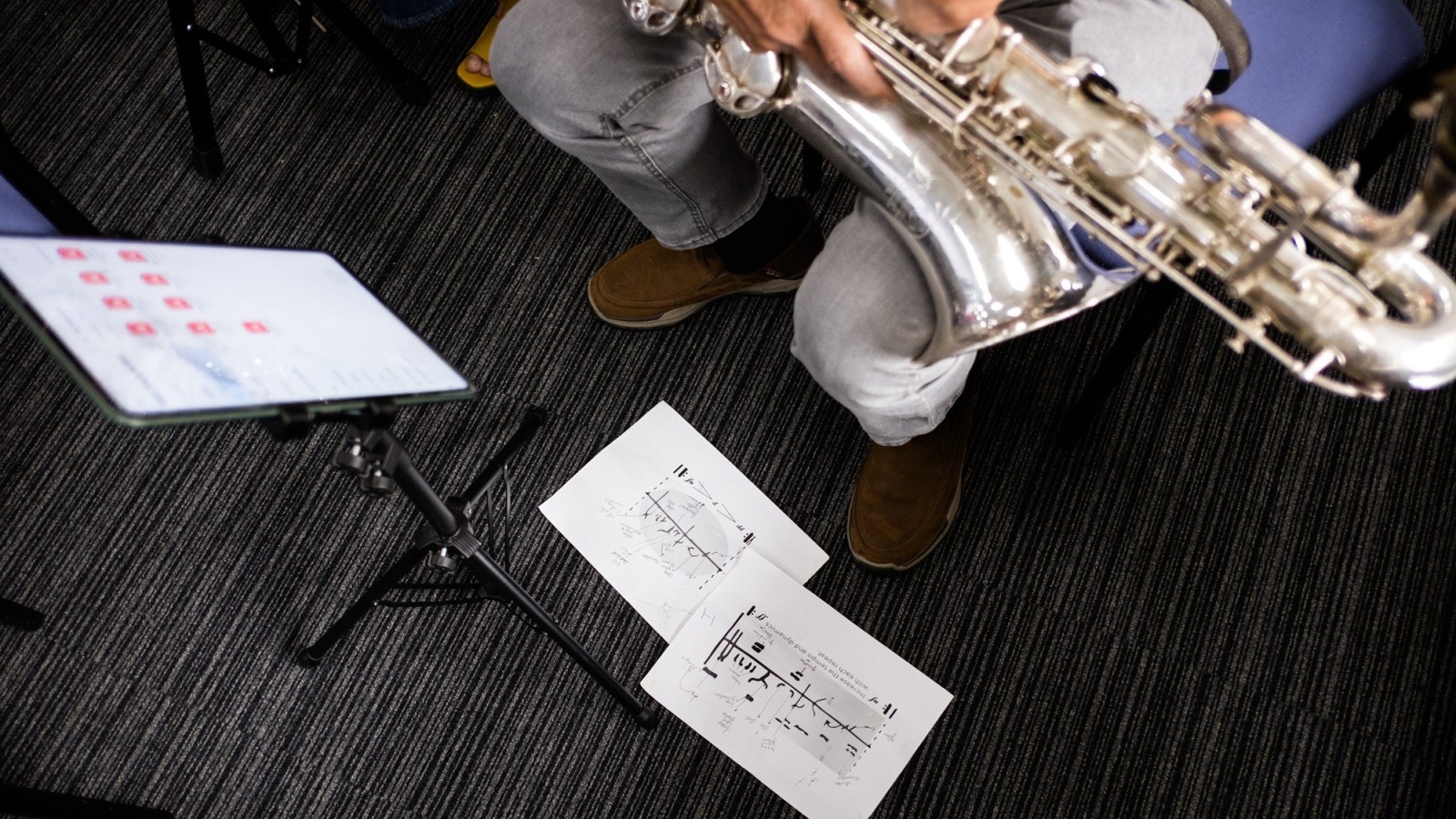
One has forgotten their instrument. Another has brought a new instrument they found at a market the day before, but do not know how to play it yet. The other three play the clarinet. One has a friend who might join, but has not confirmed whether they will be there today. And you are doing an informal performance after the rehearsal. A flexibly-scored piece might not work, as not all the parts can be covered, or it will take too long to rehearse, and your go-to pieces have been played too many times to generate enough interest from the group. What do you do? Although this describes a perfect storm of common problems when running an ensemble playing exploratory new music, these are all situations that occur on a regular basis. This anthology, and the future work it inspires, aims to provide a solution.
Running a flexible ensemble can be challenging when trying to find repertoire that includes players and singers with different skills and experience, and when it is not necessarily clear who will show up to a rehearsal. One of the main attractions of open scores is their flexibility, but many still require a lot of preparation and rehearsal. The resources and setup, understanding the methods for playing the piece, learning new notation formats, significant rehearsal time, set numbers of players and singers and many other factors can inhibit putting a piece together when time is short.
This anthology presents ways to address these practical challenges pragmatically. It is aimed at groups who want a piece to work on in a single rehearsal, where it can be performance-ready in an hour. Some of the pieces are completely open in terms of the numbers of people and resources required. Most require minimal setup, needing only copies of the score, with some pieces requiring commonly available materials and objects. Of course, all the pieces may benefit from more preparation time and rehearsal, but the focus of the anthology is to provide pieces that minimise this barrier.
The pieces in the anthology use a range of radically different strategies to meet the brief. Some pieces use generative processes that require just a short discussion among the group before carrying out the piece’s instructions. Others need players and singers to spend a short time familiarising themselves with some musical material or notation before putting it together as a group, and some might need some more conventional rehearsal. All the pieces represent an approach to creating work for immediate use by ensembles and, in addition, may suggest methods for others to use when making their own pieces.
We hope that the pick-up-and-play pieces in this anthology, along with a growing number highlighted in the CoMA Collection, provide a useful resource for musicians, educators, and community arts practitioners that offers pieces suitable for immediate performance.
James Saunders and Emory Southwick
January 2026
The scores were selected from a call for pieces in December 2025 and chosen to represent the variety received across the submission. In responding to the call, composers were asked to bear the following criteria in mind:
Pieces should have a very limited setup time from the start of the session, with no advance preparation needed. Instructions and notation should be straightforward to understand, and the pieces should be technically simple, or with a range of optional requirements. Duration must be short enough to play through more than once, or the principle clear enough to establish familiarity in a single run irrespective of duration.
The pieces should be useable by groups with a minimum of three players and potentially scalable to larger ensemble sizes, or have a set range of players (e.g. 10-20 people).
There should be no specific instrument or voice requirements, and the pieces should be useable with any resources and materials, or with broad categories (e.g. any pitched instruments). No other specialist equipment should be required, such as elaborate technical setups. Pieces should be accessible for participants with disabilities.
The anthology must include accessible pieces that do not require stave-reading skills to participate. All scores need to be accessible to participants with disabilities (especially anyone with vision or hearing impairment).
The scores were selected with CoMA’s DEI policy as a fundamental guiding principle to ensure greater representation of composers from backgrounds that are underrepresented across contemporary music in the anthology. This aligns with CoMA’s belief that musicians of all abilities and backgrounds should have access to, and be able to participate in, all aspects of contemporary musicmaking.
If you have a piece that you think will fit this brief which you would like to be considered for inclusion in the CoMA Collection, please contact music@coma.org.
This project was supported by funding from the Bath Spa University AHRC Impact Accelerator Award and Arts Council England.